


ABS vs ABS-Like Resin: Which 3D Printing Material Is Stronger?
For engineers and product designers, Acrylonitrile Butadiene Styrene (ABS) has long been the go-to thermoplastic for creating durable, functional parts—from consumer electronics housings to automotive components. Its popularity stems from a unique balance of strength, stiffness, and impact resistance.
With the rise of 3D printing, the demand for materials that can replicate these properties has led to the development of ABS-like resins and filaments. But how do these 3D-printed alternatives truly compare to traditional ABS?
This guide breaks down the key differences between ABS and ABS-like resins, helping you navigate your options for creating tough, end-use parts and functional prototypes.
What is ABS-Like Resin?
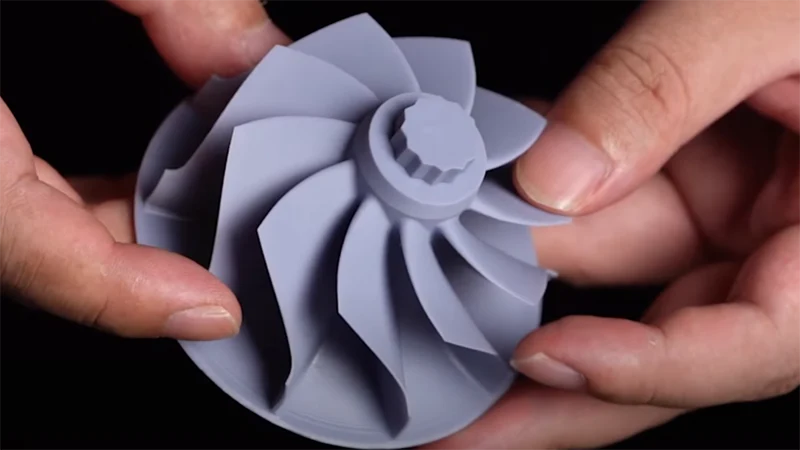
An ABS-like resin is a photopolymer designed for Stereolithography (SLA) 3D printers. Unlike standard, often brittle resins, these formulations include toughening agents—similar to the butadiene component in traditional ABS—to improve impact resistance and flexibility. The goal is to mimic the mechanical performance of injection-molded ABS, but with the design freedom of 3D printing.
Key Comparison: ABS Filament vs. ABS-Like Resin
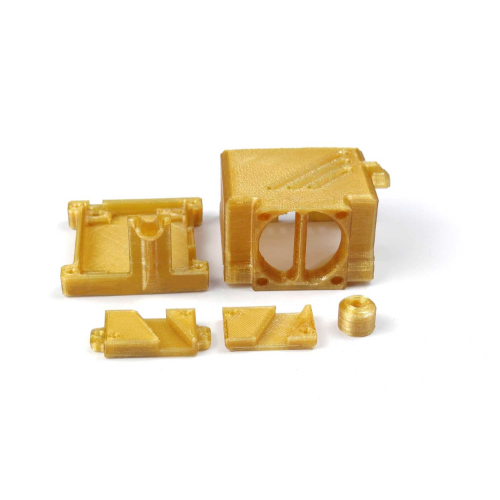
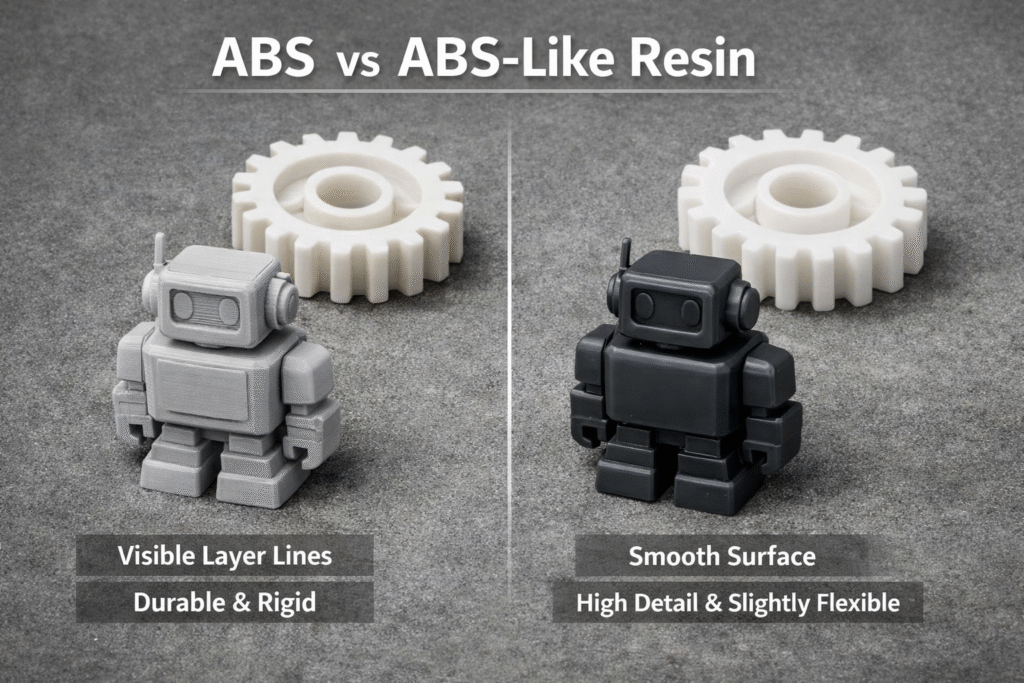
When 3D printing, you have two primary paths to achieve ABS-like properties: using ABS filament in an FDM printer, or using ABS-like resin in an SLA printer. The choice dramatically affects your part’s quality and performance.
Feature | ABS Filament (FDM) | ABS-Like Resin (SLA) |
Mechanical Properties | Anisotropic – Parts are strong in X/Y axes but weak in the Z-axis, making layer lines prone to fracturing under stress. | Isotropic – Parts are uniformly strong in all directions, similar to injection-molded plastic, for reliable, functional performance. |
Surface Finish & Detail | Pronounced layer lines require significant post-processing (sanding, vapor smoothing) for a smooth finish. | Achieves fine details and a smooth, matte finish directly from the printer, closely resembling molded parts. |
Typical Applications | Large, thick, or non-cosmetic prototypes; jigs and fixtures where surface finish isn’t critical. | Functional prototypes, snap-fit assemblies, enclosures, and end-use parts requiring both durability and aesthetics. |
Dimensional Accuracy | Good, but can be affected by warping and shrinkage common with ABS filament. | Excellent, with high resolution and the ability to produce complex geometries and thin walls. |
How ABS-Like Resin Compares to Traditional ABS
To truly understand the value of an ABS-like resin, we must look beyond the 3D printing process and compare its raw mechanical properties to those of injection-molded or extruded ABS.
Mechanical Properties at a Glance
- Tensile Strength (MPa): ABS (Injection Molded) 37.5 MPa | ABS-Like Resin (SLA) 40.4 MPa
- Elongation at Break (%): ABS (Injection Molded) 35.3% | ABS-Like Resin (SLA) 79%
- Impact Strength (Izod Unnotched): ABS (Injection Molded) NB (No Break) | ABS-Like Resin (SLA) 325 J/m
- Stiffness (Tensile Modulus): ABS (Extruded Sheet) 1800 MPa | ABS-Like Resin (SLA) 1800 MPa
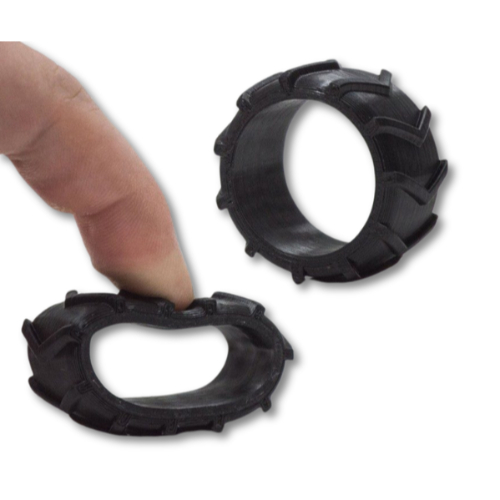
As the data shows, high-quality ABS-like resins, such as Formlabs’ Tough 2000 Resin, can achieve mechanical performance remarkably comparable to, and in some cases exceeding, that of traditional ABS. They match the stiffness and offer superior elongation at break, meaning they can flex more before snapping. This makes them ideal for applications like snap-fit enclosures and load-bearing structural components.
When to Choose ABS-Like Resin for Your Project
ABS-like resins are the perfect solution when your project demands more robustness than standard resins can offer. They bridge the gap between rapid prototyping and functional, end-use production.
Ideal Applications:
- Functional Prototypes: Test parts under real-world conditions that involve impact or stress.
- End-Use Parts: Manufacture durable components for short-run production or custom manufacturing.
- Snap-Fit Assemblies: Create parts that can flex and snap together repeatedly without breaking.
- Jigs & Fixtures: Produce durable shop tools that can withstand repeated use on the factory floor.
- Aesthetic Enclosures: Print robust housings with a smooth, production-ready finish.
Considerations:
- UV Exposure: Like traditional ABS, ABS-like resins can degrade with prolonged UV exposure. If your part will be used outdoors, plan to apply a protective coating.
- Long-Term Stability: For applications requiring a lifespan of 10-20 years, traditional engineering plastics or specific formulations should be evaluated more closely.
Best Practices for Success with ABS-Like Resin
To get the most out of your ABS-like resin prints, follow these key steps:
- Optimize Support: Due to the material’s flexibility, use adequate supports to hold the part securely during printing.
- Post-Process Correctly: Always wash your part thoroughly, then remove supports before curing. Curing with heat (using a unit like the Form Cure) is essential to unlock the material’s full toughness and heat resistance. Sanding should only be done after curing, once the part has reached its final hardness.
- Avoid Over-Curing: Excess UV exposure during or after printing can make the part brittle. Follow the manufacturer’s recommended curing times.
Conclusion: Bringing Durable, End-Use Parts In-House
For companies looking to produce parts that are tough, accurate, and aesthetically pleasing, ABS-like resin printed on an SLA platform offers a superior alternative to FDM. It delivers the isotropic strength and smooth finish of injection-molded ABS, combined with the geometric freedom of 3D printing.
By choosing the right material and process, you can move beyond basic prototyping to create durable jigs, fixtures, and even end-use parts that stand up to real-world demands.
3D Printing Service Malaysia , 3D Printing service Singapore , 3D Printing service KL , 3D Printing service Selangor, 3D Scanning Malaysia
Why Partner with Projet ?
Selecting the right manufacturing technology is important—but choosing the right manufacturing partner is what truly drives success. Not only do companies across the electronics, automotive, consumer products, aerospace, and medical industries trust Projet for our solutions, but they also value us as a dedicated partner in achieving success. Here’s why we stand out:
A True One-Stop Solution
We provide a seamless experience by offering a comprehensive suite of manufacturing services under one roof. This integrated approach streamlines your supply chain and simplifies the journey from concept to a market-ready product.
Engineering Expertise You Can Count On
Our experienced engineering team acts as a dedicated extension of your own. We excel at solving complex manufacturing challenges and collaborate closely with you to optimize your designs for quality, cost-effectiveness, and manufacturability.
Flexible Production Volumes to Match Your Needs
Whether you require a single prototype or a high-volume production run, our manufacturing capabilities are designed to scale with your demands. We support your product’s entire lifecycle, from initial launch to full-scale production.
Rapid Turnaround for a Faster Time-to-Market
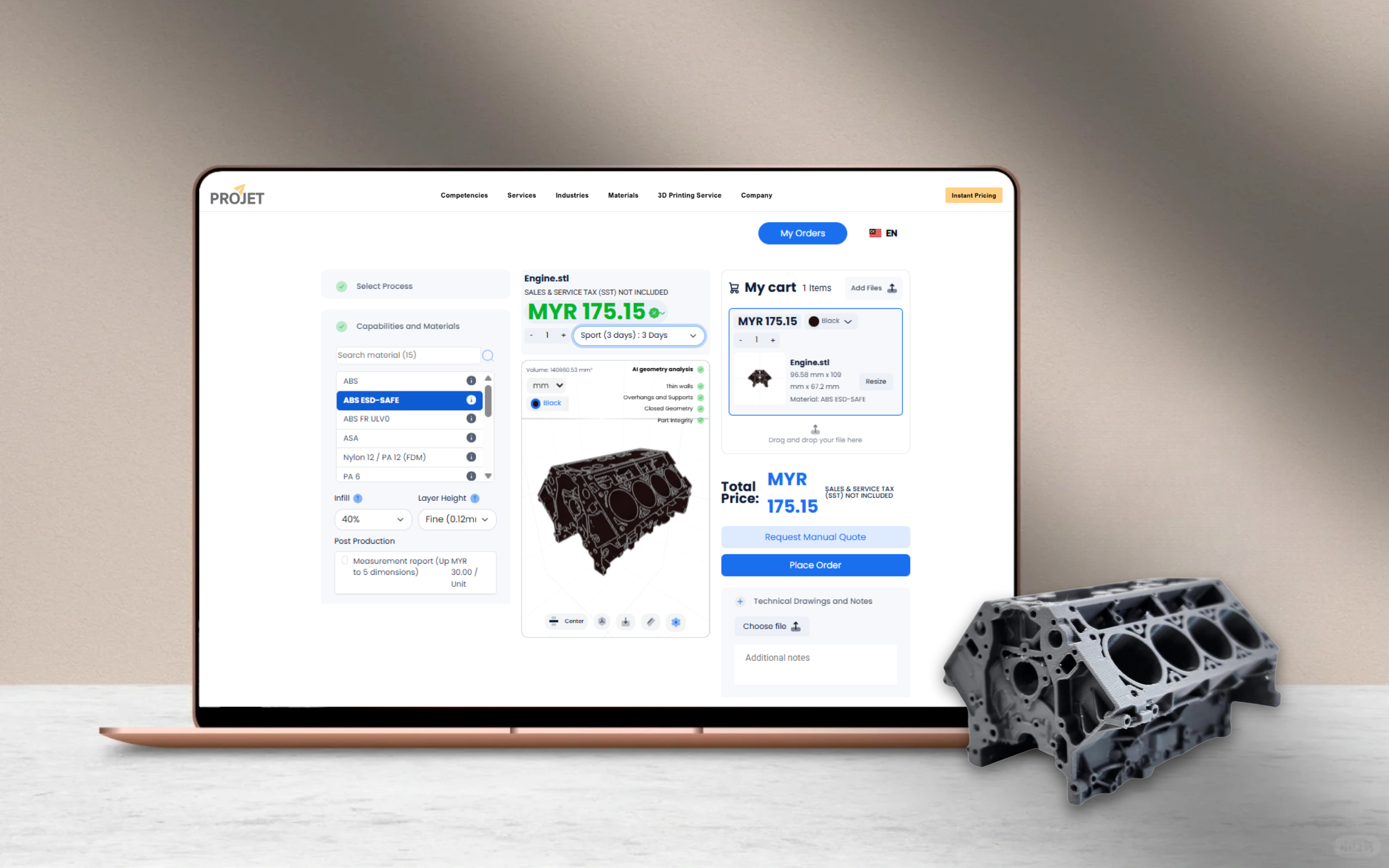
In today’s fast-paced market, speed is a crucial advantage. We deliver fast, transparent quotes and pride ourselves on our rapid turnaround times, helping you get your innovative products to market sooner.
3D Printing Services
Instant Price